
Cage, Mould-Insert & Special Nuts
Mould-insert, cage, barrel and security nuts for joints where a plain hex nut won't reach, hold or resist tampering.
Manufactured by Uvi Tech Fit in Kundli, Sonipat, India.
Or message us on WhatsApp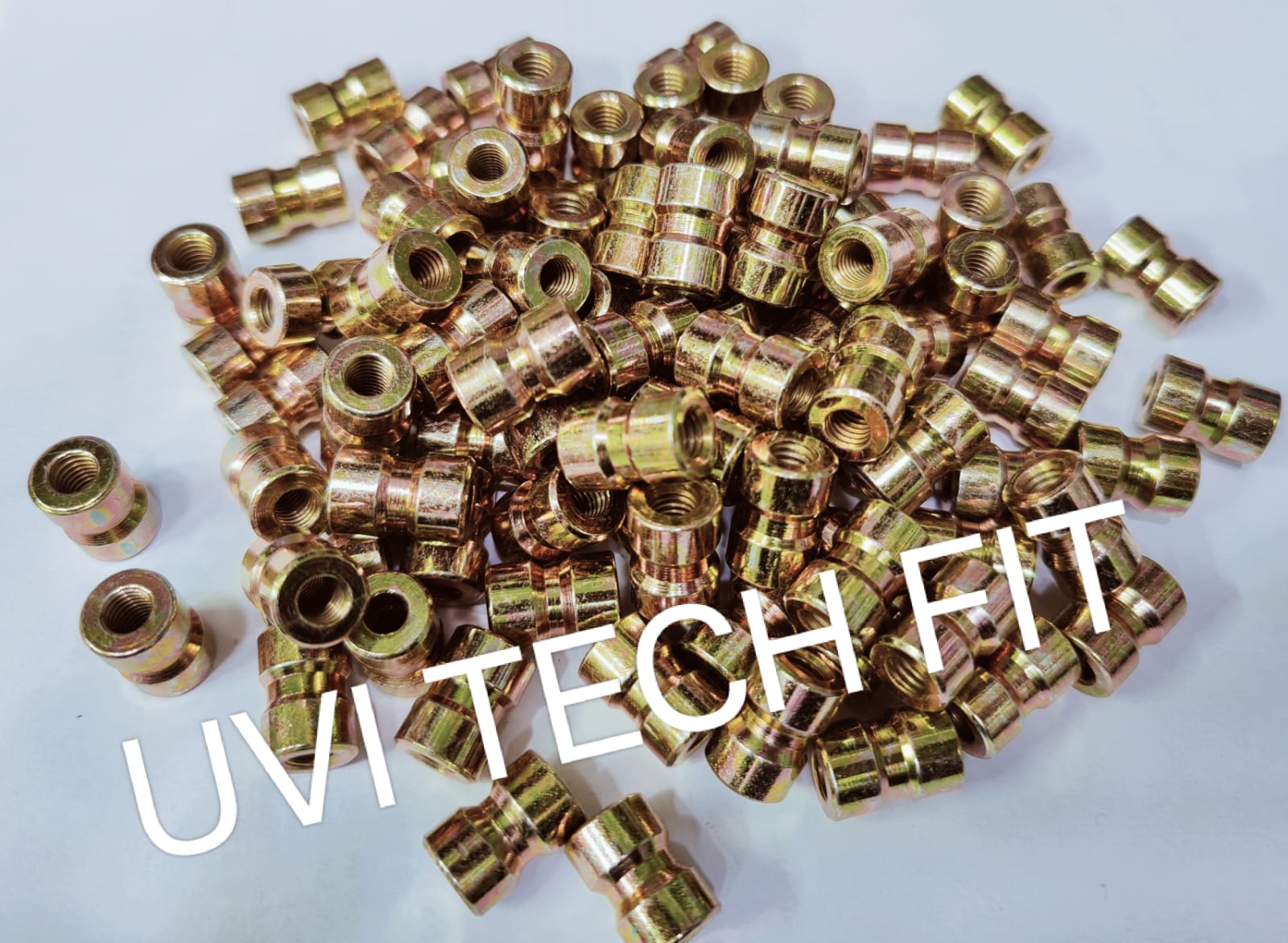
Overview
Beyond standard hex nuts, UVI supplies turned mould insert nuts for plastic moulding, barrel nuts, cage nuts for panel and rack assemblies, knurled pierce-type nuts, and two-hole security nuts. These parts solve fastening problems where a plain nut cannot reach, hold, or resist tampering.
Also known as: cage nut, mould insert nut, barrel nut.
Related parts: JCB Head Screws / Bolts, Truss Combi Screws, Combi Screws with Washer
Used in
- Plastic moulding inserts
- Furniture barrel-nut joints
- Equipment racks and panel cages
- Electrical enclosures
- Tamper-resistant assemblies
- Appliance and moulded assemblies
Specification
Common types
| Type | Where it's used | Key dimension to give |
|---|---|---|
| Cage nut | 19-inch racks (EIA-310), enclosures | Square hole 9.5 mm; panel thickness |
| Mould-insert nut | Moulded plastic parts | Knurl, OD, length, thread |
| Barrel nut | Furniture and frame joints | Barrel dia., length, cross-hole thread |
| Two-hole security nut | Public fixtures, enclosures | Pin spacing, flange size |
Cage nuts for EIA-310 racks are M6 or M5 for a 9.5 × 9.5 mm square hole. Others are made to drawing or sample.
Parts are checked at each stage with vernier calipers, micrometers and visual inspection. Material and test reports can be arranged on request.
Request a Quote
Give size, length, material, finish and quantity. For a custom part, attach a drawing or a photo of the sample.
Questions
Which cage nut fits my rack?
Standard 19-inch racks (EIA-310) use a 9.5 mm square hole. Give the rail thickness, usually 1.5–2 mm, and the thread (M6 is most common).
What is a mould-insert nut?
A knurled turned nut placed in the mould before plastic is injected, giving a metal thread that won't strip.
Do you make matching security screws?
Yes. See Security Screws & Nuts.